
Why Optimization Backfires
The trap most high performers get stuck in
I imagine, like me, you found what worked. You got good at it and then got rewarded for it. It became your superpower, part of your identity.
This strategy that built your success was a trusted one.
So you did what any rational person would do. You kept doing more of it.
Then at some point the returns started to flatten. So you pushed harder. More discipline, resilience, pushing and striving.
But you over-indexed on it until it distorted. You had a hammer and everything became a nail.
More. This is Stage 1 of the trap.
Most people don’t stay here. They’ve heard ‘what got you here won’t get you there.’ So they read the research, scroll through some IG ‘expert’ stories, befriend the AI models, and eventually talk to real human experts. They start filling the gaps. Sleep, exercise, nutrition, mindfulness, relationship coaching, exec coaching, retreats. They’re not wrong about any of it. More capacity, more leverage, better decisions. It makes sense.
But this strategy holds the same logic: identify the weakness, optimize it, extract more performance. It’s just applied to a wider set of variables that now have to be juggled. It’s still a tradeoff game. Still control. Still assumes that if you get the inputs right you can manage the outputs.
Fragmented optimization, Stage 2. More sophisticated than Stage 1. Same trap.
Here’s where it breaks.
There’s a point — the SLIP (Successful Leader Inflection Point) — where the complexity of your life and the demands on your system outpace the decision-making architecture running everything. Before that point, force works. Optimization works. You can outthink and outwork most of what comes at you.
After SLIP, the same moves cost more than they return.
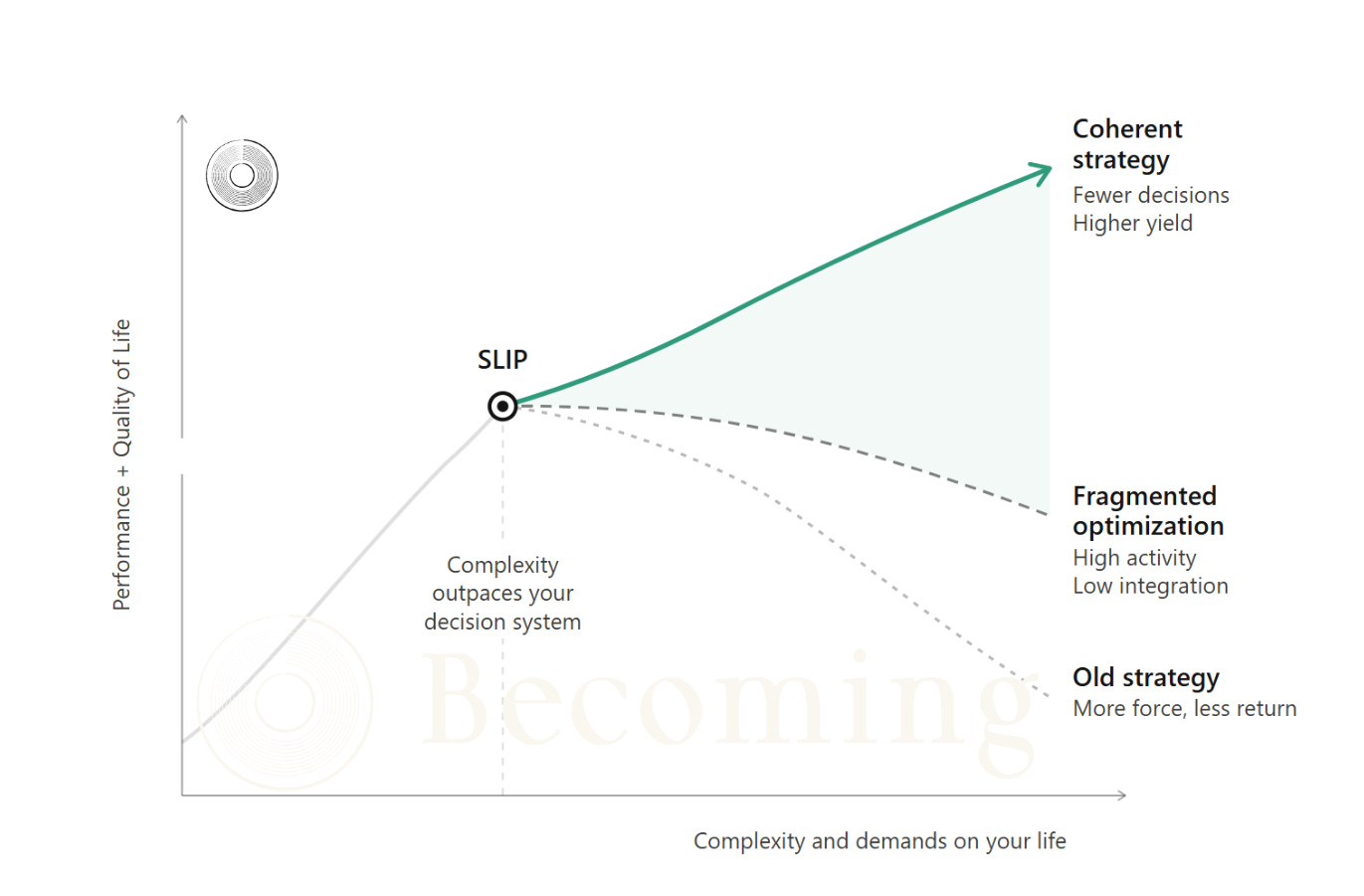
The hidden costs can be catastrophic if they aren’t caught early enough. You fall off those proverbial cliffs: failed relationships, a health scare, isolation, loss of meaning, exhaustion, apathy. Even the best outcome has you drifting far from the path you wanted to be on, too busy managing capacity to adjust direction at this speed.
The real trap is this idea that we can control all the external variables. With the right inputs, correctly managed, we should be able to produce the right outputs.
This strategy did work in the previous era. It worked when the environment was stable enough that our mental model stayed roughly accurate. That just doesn’t hold anymore. The environment changed.
Complexity today isn’t a harder version of the same problem. It’s a different kind of problem that requires a new strategy. One that can navigate through uncertainty with ease.
There are three paths. Most are on the wrong one.
Next week: The signals you have over-indexed on optimization, and what does ‘not optimizing’ look like?
SLIP - LOVE IT! great read : )